On August 3, 2026, T-Mobile switched off its 2G GSM network. The move retired the last national 2G network in the United States and ended 2G service across every major US carrier. T-Mobile described the remaining traffic as minimal and almost entirely legacy IoT devices, the alarm panels, meters, and trackers that had quietly run on 2G for years.
For the teams that managed those devices, the shutdown was not a surprise. It was a deadline. And it will not be the last one. A schedule of 2G, 3G, and early low-power network retirements now runs across North America and Europe into 2028 and beyond. Operators that treat the 2G sunset as a one-time cleanup will meet the next deadline the same way, with a scramble and a round of site visits. Operators that treat it as a pattern can design for it once.
A sunset years in the making
The US 2G shutdown was the final step in a retirement that ran for nearly a decade. AT&T closed its 2G network at the end of 2016. Verizon followed at the end of 2022. T-Mobile’s August 2026 shutoff removed what was left.
Carriers retire old networks for a straightforward reason. Spectrum is finite and valuable. Every band still carrying 2G or 3G traffic is a band that cannot carry 4G or 5G, where the same spectrum moves far more data for far more users. Refarming that spectrum improves capacity and speed on the networks that today’s devices actually depend on.
The equipment left behind is rarely a phone. It is industrial and embedded, built to run untouched for years. Fleet trackers, security panels, utility meters, and point-of-sale terminals often outlive the network generation they shipped with. When that network disappears, the device goes dark, and bringing it back means sending a technician to every location.
The next shutdowns are already scheduled
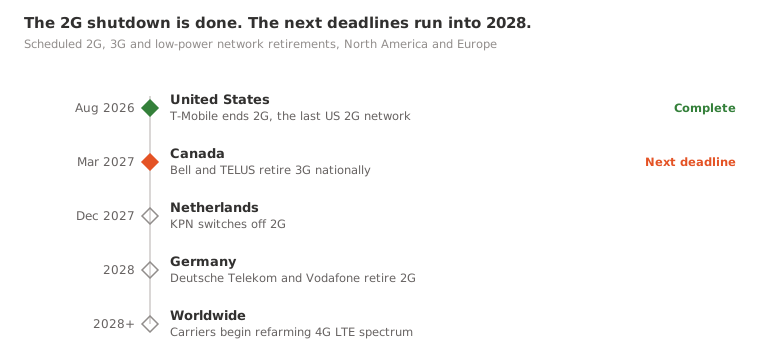
Even low-power networks are being retired. AT&T has shifted its NB-IoT traffic to LTE-M, which shows that no single network generation is permanent.
Replacing a modem is not a migration plan
Swapping a stranded device for a newer one solves today’s outage and can set up the next one. The real question is which surviving technology will still be running when the following refarm arrives.
Most new cellular IoT devices do not run on 5G. IoT Analytics reports that NB-IoT made up 33.5% of cellular IoT module shipments in 2025, LTE Cat-1 bis 21.4%, and older 4G categories 18.6%. The practical migration targets are the low-power LTE standards, not the newest radio.
Three technologies cover most IoT replacement decisions today.
- LTE-M and NB-IoT fit low-data, low-power sensors such as meters, environmental monitors, and simple trackers. Both are designed for long battery life and deep indoor coverage.
- LTE Cat-1 bis is the mid-tier workhorse. It handles moderate data and runs on existing LTE networks without waiting on 5G buildout, which makes it the pragmatic default for most devices moving off 2G and 3G.
- 5G RedCap is the forward option for higher-throughput devices such as cameras, gateways, and video telematics. Its coverage depends on 5G standalone networks, which remain uneven, so analysts expect wider adoption later in the decade.
Device lifespan matters as much as data rate. A device deployed in 2026 to last ten years should sit on a network with a long runway ahead of it, not one already on a retirement list.
Build for the next sunset, not the last one
The recurring pattern of shutdowns points to a clear design goal. Rather than tying a device to one carrier and one network generation, build the connectivity layer to change without changing the hardware.
The DB1 SIM is built for that. It carries multiple carrier identities on a single SIM, using multi-IMSI and eUICC technology, and deploys as a standard physical SIM or as an embedded eSIM. A device running the DB1 can select an available network on its own and shift to another carrier identity when one network degrades or retires a band. New carrier profiles can be added over the air, with no field visit.
VOYAGER is where that connectivity is managed. The platform brings SIMs, carrier identities, data usage, and network events into one view, with the control to move devices between carriers as coverage and sunset schedules change. The DB1 keeps devices connected across carriers. VOYAGER gives the team visibility and control over how.
Together they change what a sunset means. When a carrier retires a band, a device on a multi-carrier SIM can move to another network identity through a profile change instead of a replacement. The migration becomes an operation run from a dashboard rather than a dispatch of technicians across every site.
Sunsets are part of the plan now
The 2G shutdown is finished, but the schedule behind it is not. Canada’s 3G networks, Europe’s remaining 2G networks, and the first 4G refarms are already dated. For IoT deployments meant to run for years, the networks beneath them will keep changing. The deployments that plan for that once will spend the next decade adjusting profiles instead of replacing fleets.
Datablaze helps businesses build wireless connectivity that adapts as carriers and networks change, with the DB1 SIM for multi-carrier connectivity and VOYAGER for complete visibility and control.
Talk with an expert about preparing a fleet for the next shutdown.
Sources
Shutdown dates come from industry trackers and should be confirmed against each operator before publishing.