First Day WWAN gets a new store transacting on opening day and keeps it running when the wired line drops. This is what that looks like across a retail footprint.
The gap between ready to open and connected
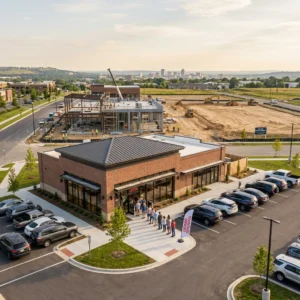
Retail growth is measured in locations, and every new location comes with a date on the calendar. A lease is signed, fixtures go in, staff are hired, and an opening day gets set. What rarely lines up with that date is the wired circuit. Broadband provisioning runs on the carrier’s timeline, not the store’s, and lead times of several weeks are common. A location can be built, stocked, and staffed and still have no way to run a point-of-sale system, process a payment, or connect to corporate systems.
That gap between ready to open and connected is the first place cellular earns its place in a retail rollout. A cellular connection can be live the moment equipment is powered on, which lets a store transact on opening day whether or not the wired line has been turned up. In many rollouts the same cellular link installed to bridge the opening becomes the location’s backup once the primary circuit arrives.
When the line drops
Backup is the second gap. A wired connection going down at a retail location is not a quiet event. Registers stop, card payments fail, and staff are left explaining to customers why the line is not moving. Cellular failover keeps the location transacting through the interruption, switching over automatically so that an outage on the primary circuit does not become an outage for the business.
One footprint, one screen
Both scenarios point to the same operational reality. A retail footprint that leans on cellular for day-one connectivity and failover ends up with cellular at every location, sometimes hundreds or thousands of them. Each connection carries a SIM, a data plan, a carrier relationship, and a usage pattern. Managing that across separate carrier portals and device manufacturer tools becomes its own job, and data costs climb quickly when plans are not matched to how each site actually uses them.
This is where the VOYAGER platform changes the equation. VOYAGER brings every SIM, endpoint, and data plan across the footprint onto one screen, so the connectivity that keeps stores open is monitored and controlled from a single login rather than reconciled across a stack of carrier accounts. Network administrators can see usage by location, catch a site trending toward an overage before the bill arrives, and troubleshoot a down connection without first hunting for the right portal.
The results
For one retail deployment, consolidating connectivity under VOYAGER produced measurable results. Tier-1 support gained a single sign-in for the tools they use most, cutting the time spent resolving routine connection issues. Cellular data costs fell by up to 32 percent once plans were selected and optimized against real usage, translating into substantially lower monthly bills. The connectivity proved reliable as both a primary and a backup path, letting branches run at optimal cost without trading away uptime.
The lesson for retail operations is straightforward. Connectivity is not only about the store that is open today. It is about the store opening next month that cannot wait for a circuit, and the store whose line drops during a Saturday rush. Cellular covers both, and a platform that manages it end to end keeps the cost and the complexity in check.